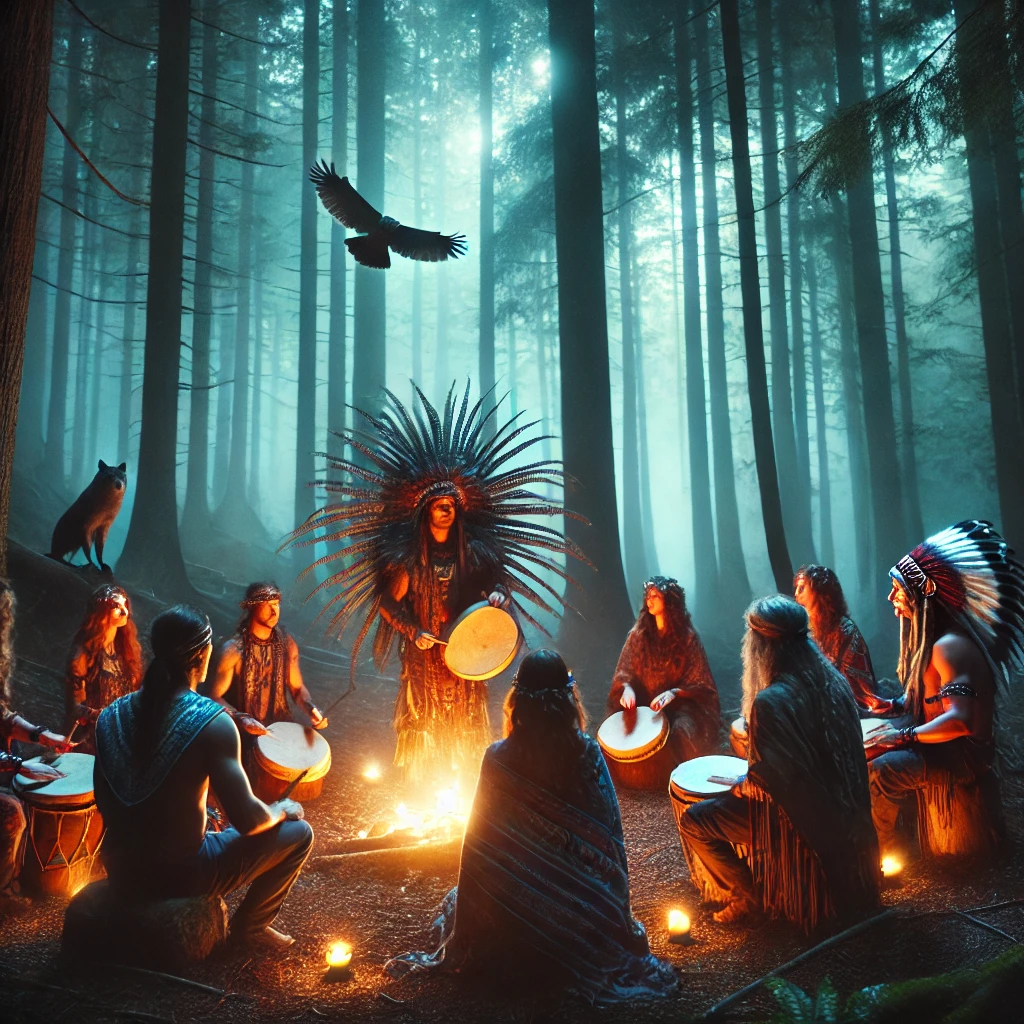
There’s a quiet truth whispering beneath the surface of modern life—one that reminds us that the world is not inert, but alive. That the tree outside your window, the ocean you long to visit, even the objects you carry with intention—all of them possess a spirit, a soul, a voice. This isn’t metaphor. It’s a worldview that many of us are reawakening to: the understanding that everything is alive and interconnected. And when embraced, it changes everything—from how we offer healing to how we hold space for the sacred.
This perspective doesn’t arise from doctrine or belief systems. It’s grounded in direct experience—dreams, journeys, intuitive communion with nature—and affirms a fundamental truth long upheld by Indigenous and animist cultures (Abram, 1996). To live this way is to return to what Martin Buber (1970) might call an “I-Thou” relationship with the world, where each being—tree, dog, stone, ocean—becomes a you rather than an it.
What does this mean for healing? First and foremost, it calls us to humility. Every being has sovereignty, including non-human and spirit beings. Healing cannot be imposed—it must be invited. Before offering support, we ask for permission. This isn’t simply good manners; it is spiritual ethics. As Berman (2000) suggests, the shift from objectification to participation is not just philosophical—it is deeply moral. Whether we’re connecting with a human, animal, tree, or park, we must honor their free will. Without consent, even a well-intentioned act may become interference or even sorcery.
In one journey, I connected with my dog Chloe—not just as a pet, but as a sovereign soul. I asked what she needed, and she offered guidance about everything from green peas in her bowl to the importance of our morning walks. But she also encouraged me to keep believing that my daughter will come into this world. She acknowledged that my shamanic path has impacted my relationship with my parents—and that it has even hurt her to witness—but assured me that if I stay committed to my purpose, I will receive all the healing I’m seeking. Her message was clear: don’t even think about giving up. Animals are not less wise than us—they simply speak a quieter language. Chloe’s presence reminded me that love can be humble, joyful, and deeply instructive.
In another journey, I returned to Two Strike Park—a place where I once played ball as a child. The land itself spoke. It told me it rejoiced in movement, strength, celebration. It asked for respect, for humans to soften with one another. It wasn’t a demand—it was a longing. These places hold memory. They are witnesses to our lives. When we treat them with kindness, they respond in kind. As Kimmerer (2013) beautifully writes, “The land loves us back.”
This sacred worldview also includes the human-made. Objects made with intention carry soul. An Atlanta Braves shamanic mask in my home, for example, revealed itself as a Witness-Warrior—part ancestral protector, part playful identity. It reminded me that every part of myself—the boy who loved baseball, the man who walks the healing path—belongs. Likewise, a male petroglyph figure became a symbol of the timeless masculine: receptive, rooted, solar, prayerful. Merging with both of these figures brought a sense of spiritual integration that words alone can’t capture. They reminded me that we are allowed to hold paradox—athlete and mystic, child and elder, human and eternal.
When I connected with the soul of a tree I sit with daily by Lake Harveston, I didn’t just see it—I felt it. As I merged with it, I experienced its telepathic empathy. It didn’t judge or analyze the people who passed beneath it—it simply witnessed. It held grief and joy equally. Later, as I danced with its spirit, the knowing deepened. I became tree: my feet roots, my spine trunk, my arms branches. The wind was emotion, the sunlight song. I wasn’t doing the dance—I was being danced. There was no effort, no striving. Just blissful awareness and holy stillness.
This is the heart of the teaching: to live in reverent relationship. To witness without needing to fix. To ask rather than assume. To know that a place can be a teacher, a dog a guide, a breeze a messenger. As Jung (1959) proposed, our deepest healing symbols emerge from within—and from without, if we learn how to listen.
We live in a world that is yearning for reconnection. This is not a call to escape modern life, but to see it differently. A paper cup may not have the soul of a redwood, but if it was crafted with care, used with gratitude, and returned to the earth with respect, it becomes part of the sacred dance. Every being we encounter has a story. And every story, when listened to with the heart, becomes medicine.
You don’t need to follow a path someone else created. You can craft your own. One rooted in direct connection, in asking permission, in walking softly and listening deeply. This is independent spirituality—not reactive or rebellious, but grounded in the sacred center of truth. It asks us not to be perfect, but to be present. To live as if everything is alive. Because it is.
Mike Bribeaux, LMFT, PhD Candidate in Integral Health, Founder, Warrior Child Healing
References
Abram, D. (1996). The spell of the sensuous: Perception and language in a more-than-human world. Vintage Books.
Berman, M. (2000). The reenchantment of the world. Cornell University Press.
Buber, M. (1970). I and Thou (W. Kaufmann, Trans.). Charles Scribner’s Sons. (Original work published 1923)
Harner, M. (2013). Cave and cosmos: Shamanic encounters with another reality. North Atlantic Books.
Jung, C. G. (1959). Archetypes and the collective unconscious. Princeton University Press.
Kimmerer, R. W. (2013). Braiding sweetgrass: Indigenous wisdom, scientific knowledge and the teachings of plants. Milkweed Editions.